
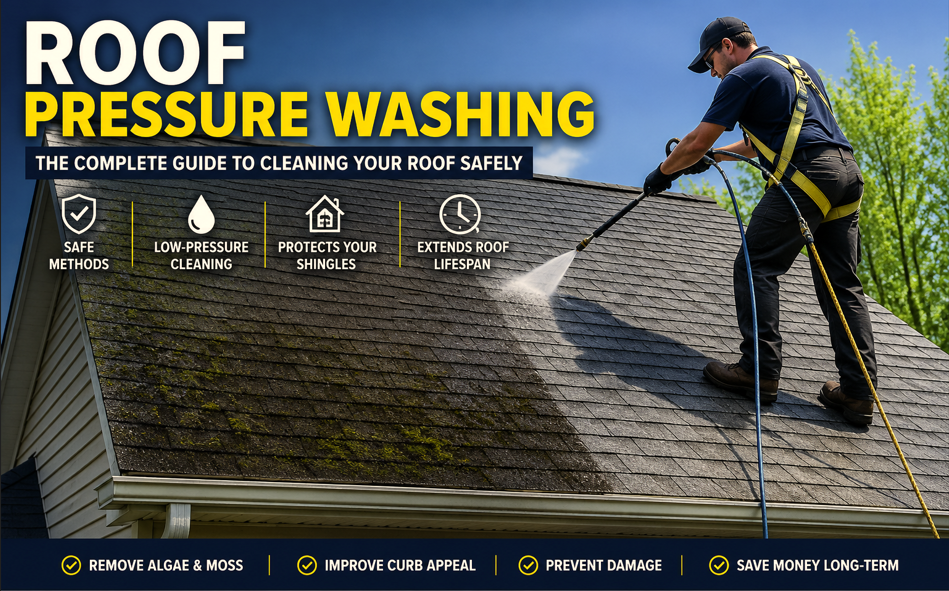
Dark streaks running down your shingles aren't just an eyesore. They're a sign that algae, moss, or dirt has been building up on your roof, sometimes for a season or more. Left alone, that buildup can trap moisture against your shingles and shorten their lifespan. The good news: roof pressure washing, done correctly, fixes this without putting your roof at risk.
This guide breaks down what roof pressure washing actually is, why soft washing is usually the safer choice for asphalt shingles, and how homeowners across Southern Indiana can tell when it's time to schedule a wash. For a full look at what we handle beyond roofs, see our professional exterior cleaning services in Southern Indiana.
What Roof Pressure Washing Actually Means
Roof pressure washing is the process of cleaning a roof surface to remove algae, moss, dirt, and dark staining. The term gets used loosely online, and that's where a lot of homeowners run into trouble.
True high-PSI pressure washing sprays water directly at a surface with significant force. That works well on driveways and siding. On an asphalt shingle roof, that same force can strip away the protective granules that keep shingles cool and shield them from sun damage, granules a roofing system depends on to last 20 years or more.
Most reputable companies use a different approach instead: a low-pressure rinse combined with a specialized cleaning solution, commonly called soft washing. The pressure washing equipment is still involved, but the cleaning solution, not water force, does most of the work. It breaks down algae, moss, and mildew at the root, and the rinse step only takes a few seconds.
Quick fact: The Asphalt Roofing Manufacturers Association (ARMA) recognizes soft washing, not high-pressure blasting, as the safer approved method for cleaning asphalt shingles.
Roof Pressure Washing vs. Soft Washing: What's the Real Difference
The difference matters more than most homeowners realize when hiring someone to work on their roof. Traditional pressure washing relies almost entirely on force, which makes it well-suited to concrete, brick, and driveways. Soft washing relies on chemistry: a cleaning solution paired with much lower pressure.
| Factor | Pressure Washing | Soft Washing |
|---|---|---|
| Typical PSI | 2,000–3,500 PSI | 500–1,200 PSI |
| Best suited for | Concrete, brick, driveways | Asphalt shingles, siding, delicate roofing |
| Cleaning method | Water force alone | Cleaning solution + low pressure |
| Risk to shingles | Can strip protective granules | Minimal risk when done correctly |
| Results longevity | Shorter, surface-level clean | Longer-lasting, treats the root cause |
For asphalt shingles, the most common roofing material across Floyd, Clark, and Harrison counties, soft washing is generally the safer, longer-lasting choice. It's the same principle behind our soft wash house washing service — chemistry does the heavy lifting, not pressure. Rather than simply clearing away surface algae, it kills the algae colony at the root, so results last considerably longer than a standard power wash.
Signs Your Roof Needs a Professional Wash
Roof buildup rarely appears overnight. It develops over one or two seasons, and by the time it's visible from the street, it's usually been building for a while. Watch for:
- Long, dark streaks running down the shingles
- Green or black patches near valleys and shaded areas
- Visible moss along roof edges or under overhanging trees
- A general dullness compared to the rest of the roof or neighboring homes
Buildup tends to happen faster on the north side of a roof and under mature trees, where shingles stay damp longer. Homes near wooded areas — including many properties we service for exterior cleaning in Georgetown, IN — often see algae growth appear earlier than homes in more open areas.
What Causes Those Dark Streaks on Southern Indiana Roofs
The dark streaking most homeowners notice comes from Gloeocapsa magma, a cyanobacterium that spreads through spores carried by wind and rain. It feeds on the limestone filler used in many asphalt shingles. Over time, the surface darkens and the growth spreads across the roof.
This isn't just cosmetic. Gloeocapsa magma holds moisture against the shingle surface, and that trapped moisture accelerates wear. As algae and moss spread along shingle edges, they can lift the edges slightly, giving water a path to seep in during heavy rain.
Is Roof Pressure Washing Safe for Asphalt Shingles?
This is one of the most common questions homeowners ask before booking a service, and the honest answer depends entirely on method.
Done with the wrong PSI or nozzle angle, pressure washing can strip granules, lift shingle edges, and weaken a roof's ability to shed water. This is the scenario that's given roof pressure washing a bad reputation in some circles.
Done correctly, with the right pressure and cleaning solution, washing an asphalt roof causes no damage and is considered routine maintenance by most roofing manufacturers. PSI, nozzle angle, and technique are what separate a safe wash from a damaging one, which is why manufacturers recommend trained technicians over DIY equipment rentals.
The Right PSI and Technique for Different Roof Types
Not every roofing material responds to pressure the same way, and a one-size-fits-all approach is where most DIY attempts go wrong.
| Roof Material | Recommended PSI | Notes |
|---|---|---|
| Asphalt shingles | Under 1,200 PSI | Combine with soft wash solution; most common in Southern Indiana |
| Metal roofing | 2,000–2,500 PSI | Can generally handle moderate pressure |
| Clay or concrete tile | Low pressure only | High pressure can crack or dislodge tiles |
| Slate roofing | Extremely low pressure | Durable but brittle under direct force |
Technicians angle the spray downward, following the direction shingles overlap, rather than spraying upward into the seams. Working section by section, and rinsing before the cleaning solution dries, prevents streaking and keeps the process controlled from start to finish.
What Happens During a Professional Roof Wash
A properly run appointment follows a consistent sequence:
- Inspection. The technician checks for existing damage, loose shingles, or areas that need extra care.
- Protection. Landscaping and gutters near the work area are covered or protected.
- Application. The cleaning solution is applied and left to sit long enough to break down algae and moss at the surface.
- Rinse. A low-pressure rinse works from the peak down.
- Final check. A walk-around inspection confirms every section was treated properly.
Most homeowners see visible improvement the same day, though heavier moss growth can take a rain cycle or two to fully release.
Common Roof Washing Mistakes That Cause Damage
Most roof-washing damage comes from avoidable errors, not from pressure washing itself. The most common mistakes:
- Using excessive PSI on shingles
- Spraying directly into shingle seams instead of following the natural overlap
- Skipping inspection, so existing damage gets mistakenly blamed on the wash
- Relying on undiluted bleach solutions, which can discolor shingles or harm nearby plants without proper runoff control
- Rushing the job and not letting the cleaning solution sit long enough before rinsing
How Often Should You Wash Your Roof?
Most roofs don't need annual washing unless they're in a particularly sunny or humid area. For Southern Indiana homes, every one to three years is a reasonable guideline, depending on tree cover, roof orientation, and how quickly algae reappears. Homes we service in wooded neighborhoods, such as those covered by our exterior cleaning crew in Greenville, IN, tend to fall on the lower end of that range because of heavy tree cover.
Waiting too long lets organisms penetrate deeper into the shingle surface, which means a more aggressive cleaning process later, and a higher risk of damage. It's generally easier to prevent heavy buildup with regular washing every couple of years than to tackle it after five or six years of neglect.
DIY Roof Pressure Washing vs. Hiring a Professional
Renting pressure washing equipment might look like the cheaper option, but it comes with real risk. Wet, algae-covered shingles get slippery fast, and falls from roof height are a genuine safety concern. Getting the PSI, nozzle angle, and chemical dilution right takes experience, and a mistake on a roof is expensive to fix.
Professional crews bring the right dilution ratios, commercial-grade low-pressure equipment built for roofing, and insurance in case anything goes wrong. For most homeowners, the time, safety risk, and learning curve of DIY outweigh the cost of hiring a professional.
How Roof Washing Protects Your Shingles and Extends Roof Life
A roof replacement is one of the most expensive costs a homeowner can face, which makes routine maintenance like regular washing worth the small investment. Removing algae and moss before they take hold prevents the moisture retention that causes granules to wear down early and shingle edges to curl and leak.
ARMA and most roofing manufacturers recognize soft washing as an approved, low-risk method precisely because it avoids the high-pressure blasting that damages shingles.
Roof Washing and Your Home's Curb Appeal and Resale Value
A clean roof changes how a home looks from the street, not just how the roofing material holds up. When buyers or appraisers spot dark streaking, they often assume neglect, even when the rest of the home has been well maintained. Pairing a roof wash with window cleaning and a driveway pressure wash is one of the most budget-friendly ways to sharpen a home's first impression, and it's a combination real estate agents frequently recommend before listing.
Roof Washing Safety Risks Homeowners Should Know
Roofing work carries risks that don't apply at ground level. Algae- and moss-covered shingles are significantly more slippery than dry ones, and ladders need firm, level footing, with proper fall protection on steep pitches, not footing alone.
There's also risk to the roof itself. Water forced under shingles can cause hidden moisture damage that doesn't show up for months, sometimes appearing as a ceiling stain or a leak during the next heavy rain. Research on Gloeocapsa magma shows the organism develops a hard, UV-protective outer coating over time, one reason aggressive high-pressure blasting alone often fails to fully remove older, established staining without proper chemical treatment first.
What to Expect From a Roof Washing Quote in Southern Indiana
Pricing depends on roof size, slope, material, and how much algae or moss has built up. Steeper roofs typically require more safety equipment and time, which affects overall cost.
A fair estimate should include an inspection, an explanation of the cleaning method being used, and details on how landscaping and gutters will be protected during the job. A trustworthy company will also tell you honestly if a different approach suits your specific roof better than a standard wash.
Roof Washing, Gutters, and House Washing: Why Bundling Makes Sense
A roof wash rarely stays contained to the roof. Debris and algae rinsed off the roof often end up in the gutters, and streaking on siding is frequently traced back to roof runoff. That's why many homeowners choose to bundle roof washing, gutter cleaning, and house washing into a single visit rather than scheduling them months apart.
Bundling is also more efficient. The same equipment and setup used for the roof often handles gutters and siding cleanup, saving time and reducing scheduling hassle.
Frequently Asked Questions
What does roof pressure washing cost?
Cost varies by roof size, pitch, and the severity of buildup. Steeper or heavily soiled roofs typically cost more due to additional safety equipment and labor time.
Will pressure washing harm my asphalt shingles?
Not if it's done correctly. Soft washing with low pressure and the right cleaning solution is safe for asphalt shingles. High-pressure blasting is what risks stripping granules and shortening shingle life.
Is it safe for me to pressure wash my own roof?
It carries real risk. Wet, algae-covered shingles are slippery, and incorrect PSI or chemical dilution can damage the roof membrane. Most homeowners are better served by a trained professional.
How long does a roof stay clean after washing?
Typically one to three years, depending on tree cover, shade, and how quickly algae recolonizes the area.
Protecting Your Roof for the Long Term
Your roof is one of the most expensive parts of your home to replace, yet routine maintenance like washing is often overlooked. Regular cleaning, matched to your specific roofing material, prevents algae and moss from taking hold, protects shingles from sun damage, and keeps your home looking consistent with the rest of the neighborhood. A simple maintenance decision like this can be the difference between a roof that reaches its full lifespan and one that needs early repairs.
Whether you handle light maintenance yourself between washes or keep a professional crew on a regular schedule, the takeaway is the same: it's always easier, safer, and cheaper to catch buildup early than to wait until it's visible from the street.
Get Your Roof Professionally Washed in Southern Indiana
If your roof is showing streaking, moss, or general buildup, waiting rarely makes the job easier or cheaper. A professional wash, done with the correct pressure and technique, protects your shingles, restores curb appeal, and catches early warning signs before they become repair bills.
Our team handles roof washing throughout Floyds Knobs and the surrounding Southern Indiana communities, using soft wash methods suited to asphalt shingles and other common local roofing materials.
Call or text (812) 370-5072 for a free quote, or request one online to get your roof back to looking the way it should.
Related reading: how dirty gutters damage your roof, siding and foundation.
Ready to Transform Your Home's Exterior?
Get a free estimate for any of our professional exterior services.