
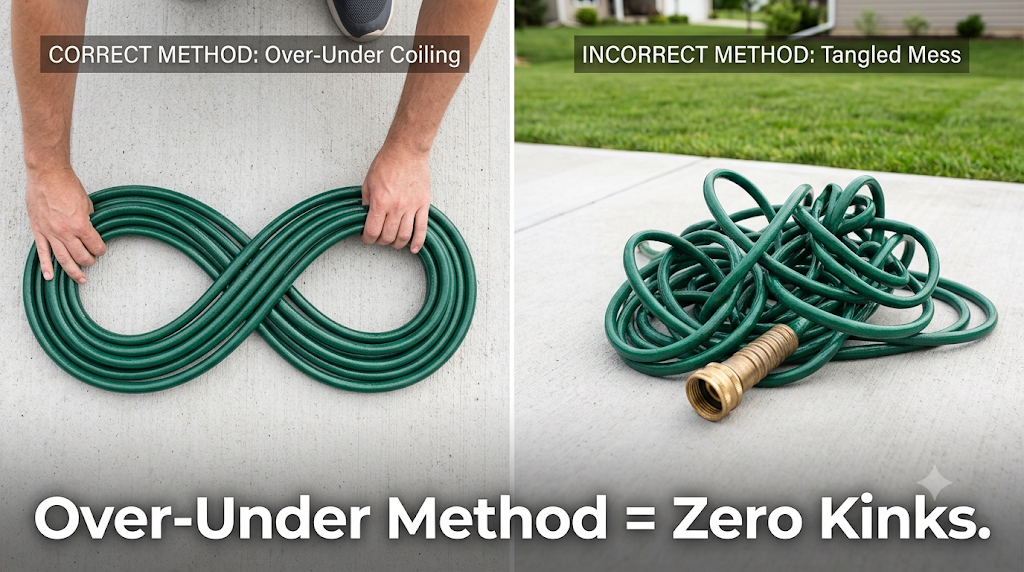
You've been there.
You finish watering the lawn or cleaning your driveway, and then comes the annoying part: coiling up that 50-foot line. You wind it "the easy way," set it down, and by the time you pick it up again, it's a tangled mess fighting you every step of the way.
Here's the truth: it's not the equipment, it's your technique.
I'm about to show you exactly how professionals store garden hoses, pressure washer lines, and every other coiled line in between. This method eliminates kinks, extends equipment life by years, and takes just a few minutes to master.
Rather not deal with the equipment at all? Hoses, ladders and pressure gear are our daily work. Book professional pressure washing in Southern Indiana or get a free quote and skip the setup and cleanup entirely.
Why Your Hose Storage Method Actually Matters
Most people don't think twice about how they coil their equipment. But here's what's happening behind the scenes:
Every time you wind in the same direction, the garden hose accumulates torsional stress. That's the inherent twisting built into the material during manufacturing.
Add twist on top of twist, and something has to give. The rubber weakens at stress points, fittings crack under pressure, and what should last five years dies in one.
The problem compounds with each use. The same kinked spot gets worse, the material fatigues faster, and eventually you're buying a replacement sooner than you planned.
But there's a solution, and it's dead simple.
The Over-Under Method: How Pros Actually Coil Lines
Professionals in pressure washing, landscaping, and film production all use the same approach: alternating loops that cancel out twist instead of compounding it.
Here's the core principle: each loop travels in the opposite direction of the last one. This neutralizes torsional stress and leaves your coiled equipment flat, compact, and ready to deploy without fighting you.
Think of it like balancing a scale. One twist left, one twist right, and the net result is zero twist.
That's the entire concept. Now let's put it into practice.
Step-by-Step: The Professional Hand-Coiling Technique
Start with a straightened line.
Lay your garden hose out completely straight, or in a loose U-shape if space is tight. This removes existing kinks and twisted sections from previous storage.
If the weather is warm, let direct sun heat the material for a few minutes. Warm rubber is more pliable and holds a coil shape far better than cold, stiff material.
Form your first loop (the "over" coil).
Starting at one end, create a loop in your hand using your normal coiling motion. This is your baseline, nothing special yet.
Flip the second loop (the "under" coil).
Here's where technique kicks in. Twist your wrist so the line flips in the opposite direction as it forms the next loop. You're essentially creating a mirror image of the first coil.
Alternate back and forth.
Keep switching: over, under, over, under. The rhythm becomes automatic after one or two full 50-foot runs.
Secure and store.
Once you've reached the end, the entire coil should sit flat in your hands or on the ground without popping open. Secure it with a hose strap, bungee cord, or any restraint that keeps it compact.
Most people get smooth with this technique inside one or two practice runs. It looks awkward at first, then it becomes automatic.
The Short-Line Alternative: When Simple Works
Got a hose under 25 feet? You can skip the alternating method.
Just spread it on the ground and hand-walk it into smaller, looser loops. Let gravity do the work instead of forcing tight coils. This approach works fine for shorter equipment without much torsional memory.
For anything longer than that? Stick with the over-under approach. It's worth the extra 30 seconds.
How Temperature Affects Your Coiling Strategy
Cold weather is your enemy.
When a hose sits in freezing temperatures, the material stiffens like rubber-coated plastic. Force it into tight coils, and you're guaranteed to crack the outer layer, or worse, split the inner lining.
Solution: Let cold equipment warm up indoors or in direct sunlight before coiling. Five to ten minutes makes the difference between equipment that lasts and equipment that fails mid-job.
Heat works in your favor, but comes with tradeoffs.
Warm hose material coils effortlessly and holds shape better. The downside? Soft material picks up debris and can stick to hot pavement, which grinds into the outer layer over time.
Quick fix: Coil in the shade when possible, and give the line a quick rinse before storage. That five-second habit prevents years of material degradation.
Storage: The Often-Missed Final Step
Coiling correctly is only half the battle. Storage is where most people fail.
Keep your coiled equipment somewhere it won't be crushed, kinked by other tools, or left in direct UV light. A wall-mounted hanger, bucket, or simple hook works perfectly.
Leaving it in a pile on the ground or stacked under equipment? That undoes all your careful coiling work within weeks.
Hand-Coiling vs. Hose Reels: Which Should You Choose?
| Factor | Hand-Coiling | Hose Reel |
|---|---|---|
| Upfront Cost | $0 | $50 to $300+ |
| Speed | Slower (more effort) | Faster (minimal strain) |
| Storage Space | Compact | Takes up room |
| Best For | Occasional homeowner use | Daily professional use |
For homeowners: Hand-coiling with the over-under method works great. A few minutes, no equipment investment, and your lawn hose stays in perfect condition.
For professionals: A reel pays for itself in reduced physical strain and time saved. Crews coiling multiple 100-foot pressure washer lines daily notice the difference immediately.
Mistakes That Kill Your Equipment Lifespan
Avoid these five habits, and your hoses will last years longer:
- Coiling the same direction every time. This accumulates twist instead of canceling it.
- Dragging over sharp edges. Lift and reposition instead of dragging around corners.
- Leaving it pressurized while kinked. This stresses inner linings and creates weak points.
- Storing in direct sun indefinitely. UV degradation happens faster than you'd think.
- Forcing a cold hose into tight coils. This cracks material and shortens lifespan dramatically.
Avoid these, and you're already ahead of 80% of equipment owners.
What Professional Pressure Washing Crews Do Differently
Here's the hidden difference between crews that replace equipment constantly and crews that run the same lines for years:
Professionals coil and uncoil multiple times every single day. That repetition makes proper technique non-negotiable. Skip the over-under method? You're burning through gear and losing productivity fighting tangled lines between jobs.
It's a small detail. But across a full workday, those small details compound into either saved time or wasted time, and cost differences that add up to hundreds per month.
Our crews at Elite Exteriors use this exact approach on every job across Southern Indiana, from Floyds Knobs to New Albany and Jeffersonville.
Quick Reference: Coiling Strategy by Equipment Length
| Hose Length | Best Method |
|---|---|
| Under 25 ft | Simple loop (either direction) |
| 25 to 75 ft | Over-under recommended |
| 75 ft+ | Over-under strongly recommended |
| Daily professional use | Hose reel over hand-coiling |
The Bottom Line
Rolling up a garden hose correctly takes less time than doing it wrong, and extends equipment life by years.
Use the over-under method for anything over 25 feet. Pre-warm cold material. Store smart. Avoid the five mistakes listed above.
That's it. That's the entire system.
Your equipment will thank you, your back will thank you, and your wallet will thank you when you're not replacing hoses every season. And when it's time for a deep clean beyond what a garden hose can handle, our professional pressure washing, soft-wash house washing, and gutter cleaning crews are one call away.
Frequently Asked Questions
How can I keep my hose from getting knotted when storing it?
The over-under coiling technique is your best defense. By alternating loop direction, you cancel out the natural twist in the material instead of compounding it. Most people master this within one or two practice runs.
Why does my hose twist even if I never twist it?
Each loop accumulates slight torsional stress when wound in the same direction. Over time, that stress builds up and creates permanent twists. The over-under method offsets each loop's twist, leaving the material stress-free.
Is it bad to coil a hose in cold weather?
Yes. Cold rubber stiffens and cracks easily when forced into tight coils. Always warm cold equipment before coiling, either indoors or in direct sunlight for 5 to 10 minutes.
Do I really need a hose reel if I hand-coil?
For occasional use, no. Hand-coiling works perfectly fine. But anyone using hoses daily, especially professionals, will find a reel saves significant time and physical strain.
Ready to protect your equipment investment? Start with the over-under method today. Your hoses will stay kink-free, last longer, and unroll without fighting you every single time. Need a hand with the heavy-duty exterior work? Get a free quote from Elite Exteriors.
Keep Reading
Ready to Transform Your Home's Exterior?
Get a free estimate for any of our professional exterior services.